Taking a Career Break as an Entrepreneur: A Stepping Stone or a Downfall?
If you scour the web for articles on career breaks or sabbaticals, you’ll quickly notice that most advice is aimed at corporate employees and focuses on helping them pitch the idea of a sabbatical to a manager. But what about entrepreneurs? When you run a small or medium-sized business (especially when you’re the only one at the helm), is it a good idea to walk away from everything for a while? How do you get buy-in from your clients? How do you ensure you come back stronger after this break?
In 2018, I took a 12-week career break, and here are some of the insights and lessons I learned…
First, why take a break?
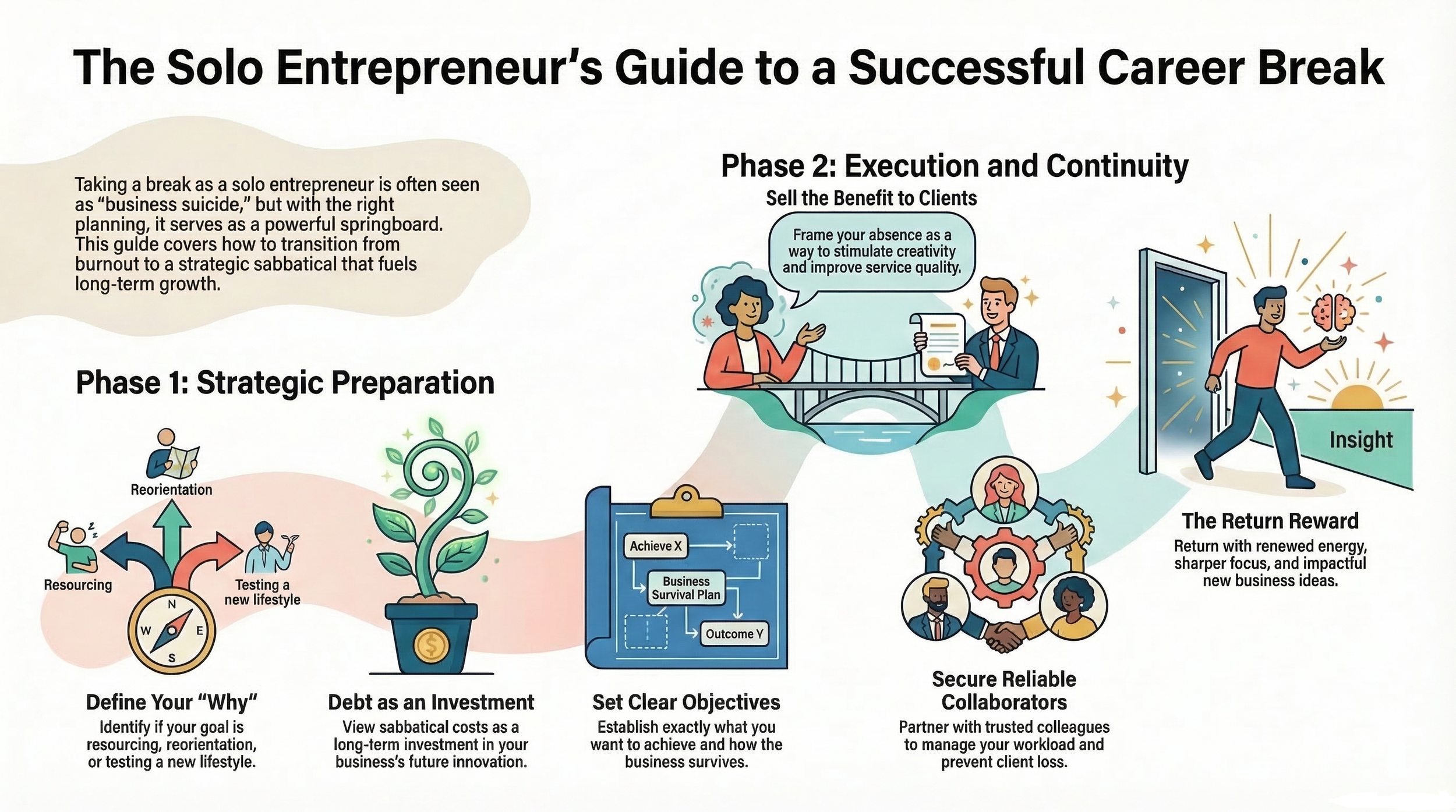
The reasons for taking a sabbatical as an entrepreneur are essentially the same as those of a corporate employee: to recharge, reset, dedicate time to a cause close to your heart, reflect on the next steps in your career, or perhaps pivot. In my case, I felt a genuine need to hit “pause” and clear my head. My business was doing well, but it was increasingly bleeding into my personal life. I needed to rethink how I ran my operations.
Even if the reasons may seem the same at first glance, the consequences of taking a break can be entirely different. In a company, an employee granted a sabbatical will have a guaranteed job upon their return. For an entrepreneur, and particularly a solopreneur, there’s no guarantee that clients will wait, especially in a highly competitive industry. But is putting everything on hold really entrepreneurial “suicide”?
Knowing How to Plan
In his compelling presentation The Power of Time Off, Stefan Sagmeister shares that he takes a sabbatical every seven years. He explains that his first one got off to a rocky start simply because he hadn’t planned how he would spend his time. While it may sound wonderful to simply walk away, let go, and follow your heart, it quickly becomes clear that a degree of structure is required to achieve your goals. For a sabbatical to be productive, it’s crucial to plan it well, set specific objectives, and take the time to answer the following questions:
· What do I want to gain from this?
· What is the primary reason for stepping away from my business during this period?
· How can I still ensure my business survives during my absence?
It is, of course, equally important to plan for this period financially—having a clear idea of the costs, as well as the resources and time required to clear any debt upon your return. If the benefits—recharging, pivoting, new ideas, and renewed energy—are positive, that debt essentially becomes an “investment” that can yield high returns in the medium or long term. For instance, Sagmeister emerged from his stay in Asia (during his second sabbatical) with a renewed passion for his work and countless concepts to apply to his graphic design. The year off ultimately paid off handsomely.
In my case, the 12-week leave resulted in some minor debt, which was easily manageable and well worth it given the long-term gains.
Selling the Idea to Clients
Once you’ve decided to take time off and have carefully planned your schedule, is it enough to simply tell your clients, “I’m off—see you soon”? Unlike the lottery commercials we used to see, you can’t say goodbye to your clients the same way you’d say “See ya, boss.” Unless you’ve decided to liquidate the business and start from scratch upon your return, you’ll undoubtedly want to reconnect with your client base when you resume operations.
While it’s important to sell the idea of the break and its benefits to a boss, your clients may not care in the slightest about your personal project—unless, of course, you can show them how it will directly benefit them. For clients, the priority will always be the continuity of service. It is therefore essential to: 1) specify the exact length of your absence; 2) provide a positive rationale (recharging, boosting creativity) to eliminate any doubt about your return; and, crucially, 3) ensure they aren't left in the lurch. In fact, if you can arrange for a person or a small team to cover your accounts during your absence so they don’t have to seek out another provider, you’ll have the ideal situation.
Stefan Sagmeister shuts down his business completely when he goes on sabbatical, but over the years he has built an international reputation that practically guarantees a steady client base. This isn’t the case for most entrepreneurs—it certainly wasn’t for me. But that shouldn’t stop small business owners from taking a sabbatical if the break is necessary. All you need to do before leaving is ensure you have reliable partners in place.
Collaborating Without Losing Your Clients
That’s the million-dollar question. How can I leave without stressing out, leave my clients in the hands of others, and get my clients back when I return? This, of course, is where the greatest risk always lies, which is why it’s important to work with collaborators you’ve known for some time, whom you trust, and with whom you can establish clear ground rules. It’s also always possible, of course, that a client might prefer to keep on working with one of your collaborators rather than return to you upon your return from a sabbatical. If you love your work and excel at it, if you have good collaborators, and if you clearly explain the situation to your clients—and if you make the most of this break—you should find a similar client base upon your return and be able to help your business thrive. And who knows, the little “shake-up” that may have occurred in your client base during your absence could also be beneficial.
My personal experience
I took a 12-week break in the fall of 2018. Burned out and needing to recharge, but also eager to perfect a new language, I decided to spend time in Asia (primarily Japan). I also wanted to break free from my work environment, which had become too confining. I had long dreamed of becoming a digital nomad, and I needed to test this lifestyle on a small scale before committing to it full-time. I was able to find excellent collaborators who ensured continuity during my absence, and the majority of my clients accepted the break and returned to me upon my return.
The experience was transformative, and I now know beyond a shadow of a doubt that I want this nomadic lifestyle and that I can make it work. I also came back with ideas to scale my business and have a greater impact on my clients’ results, as well as rewarding personal projects that might one day yield business benefits. I returned rested, energized, and ready to take on new challenges.
Taking a career break as an entrepreneur isn’t necessarily “business suicide.” Like any project, it’s important to plan it well, ask the right questions, and put the necessary systems in place before you leave to facilitate your return and ensure success afterward. The benefits of such a break can far outweigh the risks involved!